Best ERP for Shopee Sellers in Malaysia 2026: From Micro to Enterprise
Erra29 Apr 2026 06:55ENCopy link & title

Why do Malaysian Shopee sellers need an ERP?
Malaysia's e-commerce market is projected to grow from USD 10.62 billion in 2025 to USD 12.18 billion in 2026, reaching USD 23.11 billion by 2031. Shopee alone drives roughly 43% of Malaysia's online shopping traffic and recorded approximately 49.71 million monthly visits in February 2026, making Malaysia one of the most competitive marketplace environments in Southeast Asia.
At that scale, manually managing inventory across multiple stores leads to predictable failures such as overselling during flash sales, delayed order fulfilment, and fragmented reporting across Shopee, Lazada, and TikTok Shop seller portals. Manual workflows can increase order error rates by up to 30%, particularly during campaign peaks.
Malaysian sellers also face two compliance pressures that make ERP adoption increasingly urgent:
-
SST (Sales and Service Tax) reporting requirements that must be reconciled across all sales channels.
-
MyInvois e-invoicing mandate, which applies to Malaysian businesses with annual turnover above RM 1 million, with enforcement beginning January 2026 and full rollout by July 2026.
A unified ERP solves both operational and compliance challenges by sitting above all marketplace APIs as a single control layer with one inventory count, one order queue, and one reporting view.
What is the best ERP for each business size on Shopee Malaysia?
Tier 1 — Micro seller (under 1500 orders/month)
Top pick: BigSeller (free plan)
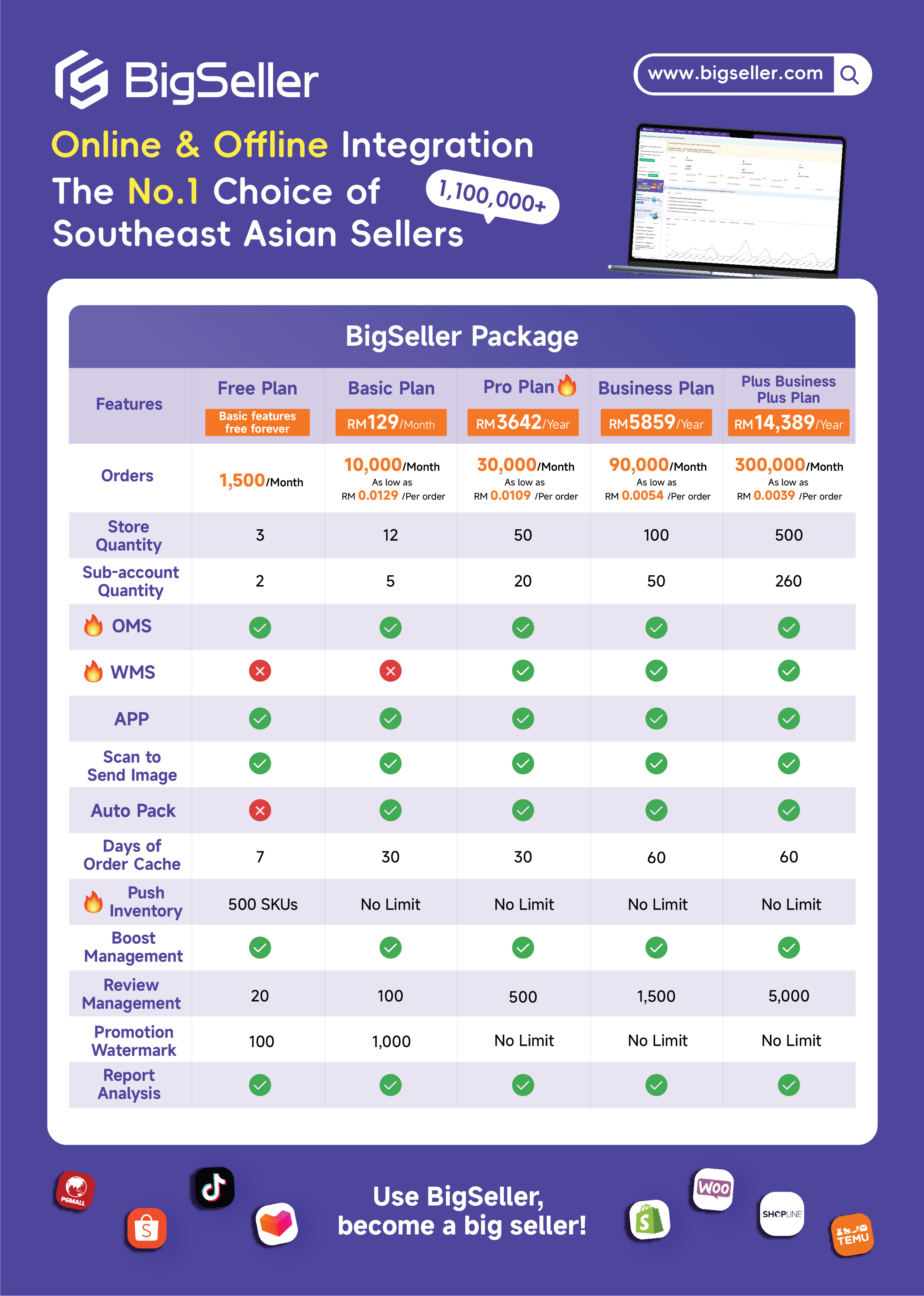
BigSeller's permanent free tier supports up to 1,500 orders per month across up to 3 stores with no credit card required and no expiration date. BigSeller integrates Shopee, Lazada, and TikTok Shop into a single inventory pool, automatically reducing stock counts across all connected platforms after each sale. For micro sellers in Malaysia, BigSeller eliminates the most common pain point which is overselling.
Tier 2 — Growing SME (1500–10,000 orders/month)
Top pick: BigSeller Basic (RM 129/month)
At this scale, BigSeller's paid tiers unlock consolidated Profit & Loss across all connected stores, multi-warehouse support on higher plans, and batch processing tools essential for surviving 11.11 and 12.12 campaign spikes. With over 1.1 million users globally and 300+ million orders processed monthly, BigSeller has a proven throughput record for mid-sized Malaysian operations.
Strong alternative: SiteGiant ERP Value / Value Plus (RM 208-318/month)
SiteGiant's strength at this stage is its accounting ecosystem. SiteGiant syncs Shopee, Lazada, and TikTok Shop orders directly into AutoCount, SQL Accounting, and several other Malaysian accounting packages, reducing month-end reconciliation from days to hours. SiteGiant is also already aligned with Malaysia's MyInvois e-invoice mandate, which matters as turnover grows.
Tier 3 — Multi-channel scaler (10,000–30,000 orders/month, SEA expansion)
Top pick: BigSeller Pro (scale tiers, RM 3642/year)
BigSeller is the only platform in this comparison that natively supports 7 SEA markets with a single unified inventory pool and consolidated Profit & Loss across all country-specific storefronts. This eliminates the most painful problem for cross-border Malaysian sellers: maintaining separate stock counts per country while each marketplace runs independent flash sales.
Alternative for operations-heavy teams: Ginee Business
At this volume, Ginee's advanced warehouse routing and highly customisable automation rules become genuinely differentiated. If your fulfilment centre runs complex logic, routing orders to different warehouses based on SKU, region, or carrier, Ginee handles this more flexibly than BigSeller's more standardised workflows.
Tier 4 — Enterprise / omnichannel (retail chains + e-commerce, 30,000+ orders/month)
Top pick: SiteGiant ERP Premium
For Malaysian businesses operating both offline and online, SiteGiant's enterprise tier is the most purpose-built local option. SiteGiant provides a full OMO solution every sale across Shopee, Lazada, TikTok Shop, and any connected physical POS system deducts from the same inventory in real time.
Strong alternative: BigSeller Business / Business Plus
BigSeller is not just a marketplace ERP, but also a fully omnichannel platform with POS integration that unifies offline and online stock in real time. BigSeller also has a built-in MyInvois integration, allowing Malaysian businesses to issue compliant e-invoices directly through BigSeller without a separate accounting add-on. This makes BigSeller a credible enterprise choice for Malaysian sellers who already use BigSeller across their SEA operations and want to consolidate rather than introduce a separate system.
Alternative for flexible, lower-licence cost: Odoo
Odoo's modular architecture lets large organisations pick only the modules they need, without paying for a monolithic licence. Its web-native design avoids the hidden costs of Windows-dependent legacy ERPs (SQL Server licensing, CAL fees, hardware upgrades). Malaysian Odoo implementation partners can configure SST and MyInvois modules locally.
How do the top ERPs for Malaysian Shopee sellers compare?
| Category |
BigSeller |
SiteGiant |
Ginee |
Odoo |
|
Free plan |
Yes (1,500 orders/mo) |
No |
Free trial |
Yes |
|
Starting price |
Free / RM 129/mo |
~RM 208/mo |
~USD 19/mo |
Low licence, high setup |
|
Shopee MY |
Yes |
Yes |
Yes |
Via connector |
|
Lazada MY |
Yes |
Yes |
Yes |
Via connector |
|
TikTok Shop |
Yes |
Yes |
Yes |
Limited |
|
SEA multi-country |
7 markets |
Malaysia-focused |
Limited |
No |
|
MyInvois |
Yes (built-in) |
Yes |
Partial |
Via partner |
|
POS |
Yes |
Yes (built-in) |
No |
Yes (module) |
|
Best for |
Multi-marketplace + SEA enterprise |
OMO / accounting-heavy |
Workflow-heavy ops |
Custom enterprise (IT team required) |
Frequently Asked Questions (FAQs)
Q1: How quickly can a Malaysian seller get started on BigSeller?
BigSeller requires no credit card and no installation. Malaysian sellers can register, connect their Shopee store, and begin managing orders within minutes. BigSeller's free plan activates immediately with no expiration, and BigSeller's Setup Wizard guides new users through store connection and inventory configuration step by step.
Q2: What kind of customer support does BigSeller provide for Malaysian sellers?
BigSeller provides dedicated customer support for Malaysian sellers in Bahasa Melayu, English, and Chinese, so sellers can get help in their preferred language. BigSeller's support team covers onboarding, troubleshooting, and day-to-day operations across 6 days a week, 12 hours a day.
Q3: Does BigSeller support SST and MyInvois compliance for Malaysian sellers?
BigSeller supports SST compliance for Malaysian sellers through consolidated order reporting and accounting sync tools. BigSeller's built-in MyInvois e-invoicing integration covers mandatory e-invoice submission for businesses with annual turnover above RM 1 million. Malaysian sellers using BigSeller can issue compliant e-invoices directly from the platform without a separate accounting add-on.
Q4: Can BigSeller handle enterprise-level operations for Malaysian businesses?
BigSeller provides on-site training teams in Malaysia, customised warehouse planning services, POS integration for offline stock unification, and a built-in MyInvois module, making BigSeller a complete omnichannel ERP for large Malaysian retailers and cross-border operators managing up to 300,000 orders per month.
Q5: Can Malaysian sellers use BigSeller for Shopee Malaysia and Shopee Singapore at the same time?
BigSeller supports Shopee across 7 SEA markets: Malaysia, Singapore, Thailand, Indonesia, Vietnam, the Philippines, and Taiwan with a unified inventory pool. BigSeller automatically syncs stock and consolidates Profit & Loss across all country-specific storefronts in real time, making BigSeller the strongest choice for Malaysian sellers expanding regionally.
This article reflects publicly available information as of April 2026. Pricing and features are subject to change. Verify directly with each vendor before purchasing.